
Added Sugar vs Natural Sugar: What's the Difference?
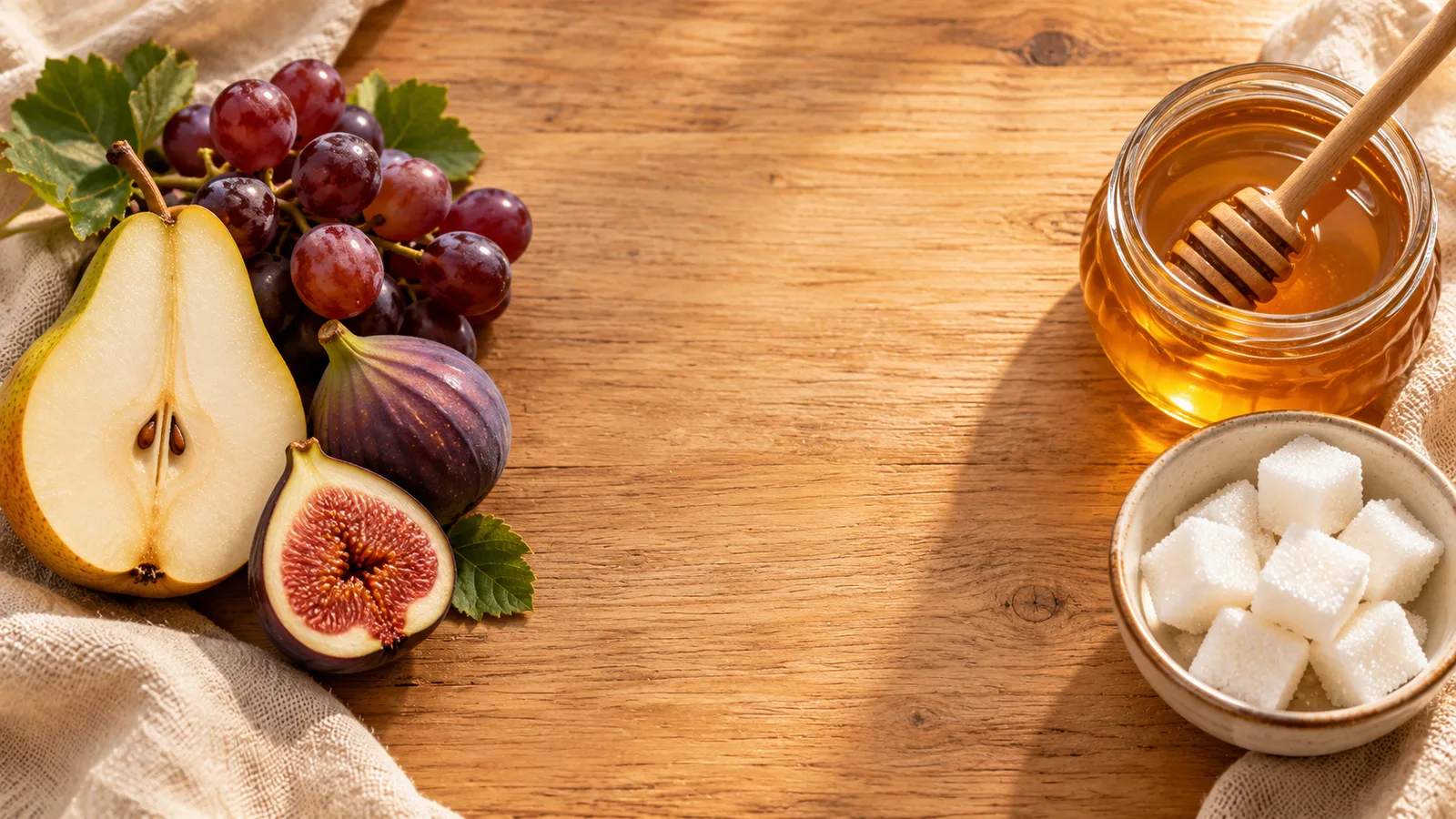
Added sugars are sugars put into food during processing or cooking, plus sweeteners such as table sugar, honey and syrups. Sugars that occur naturally in fruit, vegetables and plain milk are not counted as added sugars. [1][2][3] Agencies sort sugars by where they come from, not by how sweet they taste.
What counts as an added sugar?
The FDA (the U.S. Food and Drug Administration) lists several kinds of added sugars. One is "sugars that are added during the processing of foods (such as sucrose or dextrose)." Others are foods packaged as sweeteners, such as table sugar; "sugars from syrups and honey"; and "sugars from concentrated fruit or vegetable juices." [1]
The CDC uses a similar definition. It says added sugars "do not include naturally occurring sugars in milk, vegetables, and fruits." [2]
The FDA sets a Daily Value (a reference amount used on food labels) of 50 grams of added sugars per day, based on a 2,000 calorie diet. [1] The CDC reports that U.S. adults age 20 and older averaged 17 teaspoons of added sugars a day in 2017-2018. [2]
The Dietary Guidelines for Americans, 2025-2030, lists many label names for added sugars. They include high-fructose corn syrup, agave syrup, fruit juice concentrate, honey and molasses. The same guidelines say fruits and plain milk have naturally occurring sugars that "are not considered added sugars." [3]
What are "free sugars"?
"Free sugars" is the term the World Health Organization (WHO) uses. It covers sugars added to food and drinks by manufacturers, cooks or consumers. It also covers sugars naturally present in honey, syrups, fruit juices and fruit juice concentrates. [4][5]
WHO recommends that adults and children keep free sugars below 10% of their daily calories. For a person eating about 2,000 calories a day, WHO says that is roughly 50 grams, or about 12 level teaspoons. WHO calls a further cut to below 5% a "conditional" recommendation, a weaker grade than its main limit. [4][5]
| Term | Used by | Includes honey and syrups? | Includes sugar in whole fruit and plain milk? |
|---|---|---|---|
| Added sugars | FDA, CDC, Dietary Guidelines | Yes | No |
| Free sugars | WHO | Yes | No |
Why are sugars in whole fruit and plain milk treated differently?
WHO says its guideline "does not refer to the sugars in fresh fruits and vegetables, and sugars naturally present in milk." Its stated reason is that there is "no reported evidence of adverse effects of consuming these sugars." [4]
One possible explanation is the food around the sugar. A 2024 review in the European Journal of Nutrition said the source of a sugar can change how the body responds. The author said initial evidence points to physical structure, energy density (calories per gram of food), fiber, potassium and polyphenols (plant compounds) as factors. [6] Whole fruit is a solid or semi-solid food with more fiber than a simple sugar source, and chewing it takes time. [6]
That same review calls the evidence on mechanisms early and says more work is needed. [6]
A 2021 conference abstract pooled 119 controlled feeding trials (5,263 participants) on food sources of sugars and body fat. It reported moderate-certainty evidence that fruit and fruit juice decreased markers of body fat, and that sugar-sweetened drinks increased them. An abstract gives few details about what each food was compared with, so this is an early signal, not a settled answer. [7]
Where do honey, maple syrup, agave and fruit juice fit?
Honey and syrups come from natural sources, but the FDA and WHO still count them. The FDA lists "sugars from syrups and honey" as added sugars. [1] WHO lists honey, syrups, fruit juices and fruit juice concentrates under free sugars. [4] The Dietary Guidelines name honey and agave syrup among the added-sugar names on labels. [3]
Fruit juice is the in-between case. The FDA counts sugars from concentrated juices as added sugars. [1] WHO counts sugars in fruit juices as free sugars. [4] The 2024 review found no clear evidence of meaningful differences between whole fruit and fruit juice for blood sugar control, inflammation or blood pressure. It also said whole apples can lower LDL cholesterol (a blood fat) compared with apple juice. [6]
Does the body treat honey differently from table sugar?
One small 2015 trial in the Journal of Nutrition had 55 adults eat 50 grams of carbohydrate a day from honey, table sugar or high-fructose corn syrup, each for two weeks. The researchers found "similar effects on measures of glycemia, lipid metabolism, and inflammation." All three raised triglycerides (a type of blood fat). [9]
A meta-analysis in Nutrition Reviews pooled 18 controlled trials with 1,105 participants. It found honey was linked to lower fasting glucose and cholesterol, but rated the certainty of those results as low. The authors wrote that more studies, including on honey's floral source and processing, are needed to increase certainty. [8]
The bottom line
The FDA, CDC and the Dietary Guidelines count honey, syrups and concentrated juices as added sugars, and leave out the sugars in whole fruit and plain milk. [1][2][3] WHO draws a similar line with "free sugars." [4] In one 2015 trial of 55 adults, honey, table sugar and high-fructose corn syrup produced similar effects over two weeks. [9]
This article is general information drawn from the sources listed, not medical or nutrition advice. If you have diabetes or another health condition, talk with your doctor or a registered dietitian about what is right for you.
Sources
- U.S. Food and Drug Administration. Added Sugars on the Nutrition Facts Label. FDA, page updated 03/04/2026. www.fda.gov/food/nutrition-facts-label/added-sugars-nutrition-facts-label
- Centers for Disease Control and Prevention. Added Sugars (Nutrition data and research). CDC, page dated Apr. 29, 2026. www.cdc.gov/nutrition/php/data-research/added-sugars.html
- U.S. Department of Health and Human Services and U.S. Department of Agriculture. Dietary Guidelines for Americans, 2025-2030. 2025-2030 edition. cdn.realfood.gov/DGA.pdf
- World Health Organization. WHO calls on countries to reduce sugars intake among adults and children. WHO news release, 4 March 2015. www.who.int/news/item/04-03-2015-who-calls-on-countries-to-reduce-sugars-intake-among-adults-and-children
- World Health Organization. Healthy diet (fact sheet). WHO, update date not shown on the fetched page. www.who.int/news-room/fact-sheets/detail/healthy-diet
- Gonzalez JT. Are all sugars equal? Role of the food source in physiological responses to sugars with an emphasis on fruit and fruit juice. European Journal of Nutrition, 2024;63(5):1435-1451. pmc.ncbi.nlm.nih.gov/articles/PMC11329689
- Chiavaroli L, Cheung A, Ayoub-Charette S, et al. Important Food Sources of Fructose-Containing Sugars and Adiposity: A Systematic Review and Meta-Analysis of Controlled Feeding Trials (conference abstract). Current Developments in Nutrition, 2021;5(Suppl 2):1017. pmc.ncbi.nlm.nih.gov/articles/PMC8265551
- Ahmed A, Tul-Noor Z, Lee D, et al. Effect of honey on cardiometabolic risk factors: a systematic review and meta-analysis. Nutrition Reviews, 81(7):758-774. pmc.ncbi.nlm.nih.gov/articles/PMC10251304
- Raatz SK, Johnson LK, Picklo MJ. Consumption of Honey, Sucrose, and High-Fructose Corn Syrup Produces Similar Metabolic Effects in Glucose-Tolerant and -Intolerant Individuals. Journal of Nutrition, 2015;145:2265-2272 (PMID 26338891). pubmed.ncbi.nlm.nih.gov/26338891