
Erythritol, allulose, monk fruit, stevia: what are they?
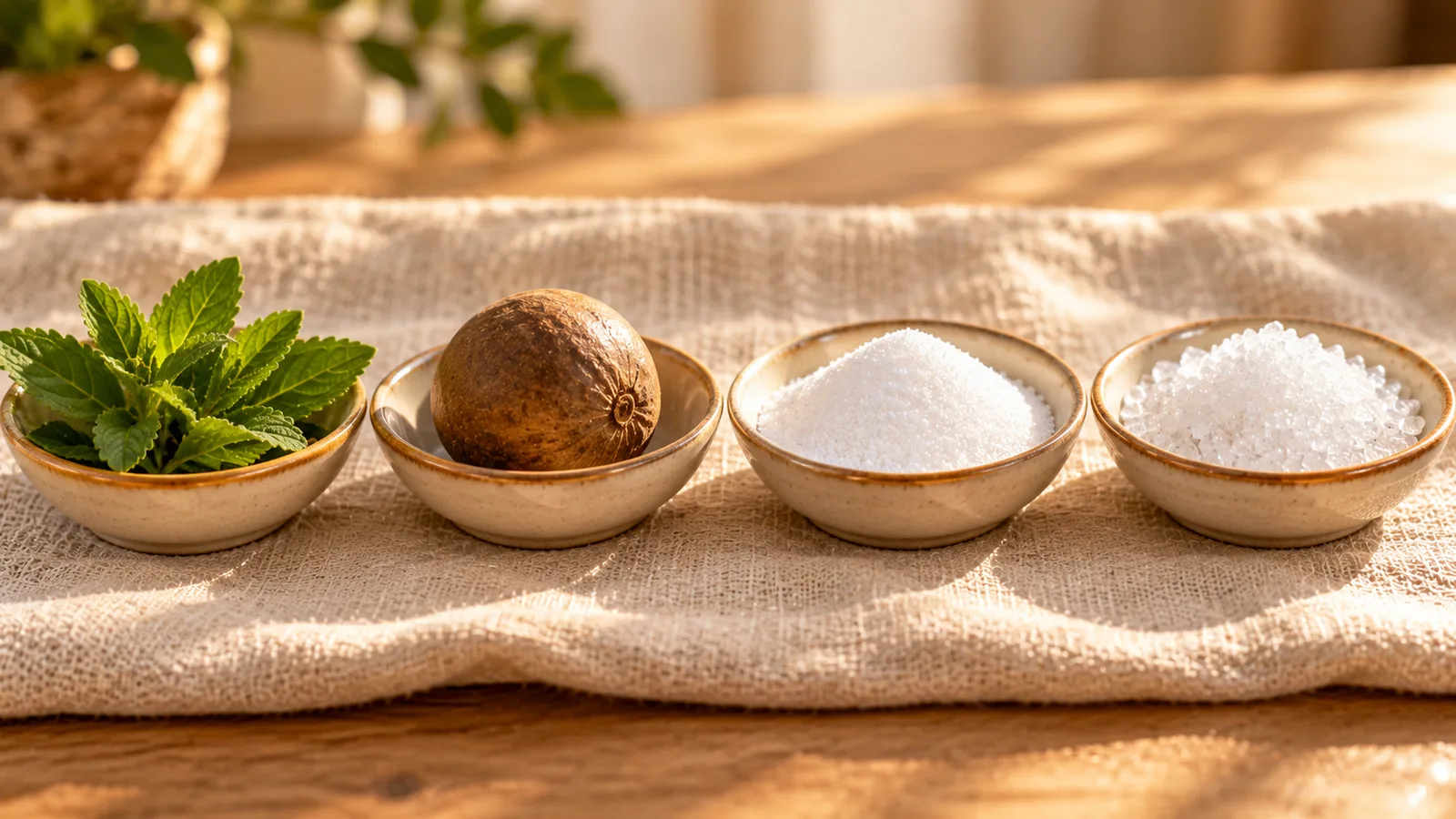
Erythritol is a sugar alcohol. Allulose is a rare sugar. Monk fruit and stevia are plant extracts, 100 to 400 times sweeter than sugar [2]. All four add few or no calories [5][11][14]. Each has its own FDA status and research record. The research on erythritol and the heart is covered below.
What is a sugar alcohol, and what are these four sweeteners?
A sugar alcohol (also called a polyol) is a sweetener with fewer calories per gram than sugar. It is also less sweet [1]. Erythritol, sorbitol and xylitol are examples [2]. Allulose is not a sugar alcohol. The FDA calls it a sugar that the body uses differently than traditional sugar [14].
| Sweetener | What it is | Sweetness vs. sugar | Calories per gram |
|---|---|---|---|
| Erythritol | A sugar alcohol found in melon, pears and grapes. Companies make it by fermentation [5]. | About 70% as sweet [5] | Estimated under 0.4 [5] |
| Allulose | A rare sugar found in maple syrup, dried fruit and brown sugar [12] | About 70% as sweet [12] | 0.4 under FDA policy. Sugar has 4 [14] |
| Monk fruit | Extract of a fruit native to southern China [2] | 100 to 250 times sweeter [2] | Few to none [11] |
| Stevia | Extract from the leaves of the Stevia rebaudiana plant [2] | 200 to 400 times sweeter [2] | Few to none [11] |
Is erythritol safe?
Studies have found a link between higher blood erythritol and heart events. Whether erythritol causes those events has not been shown. Here is what the main studies found.
A 2023 study in Nature Medicine measured erythritol in the blood of three groups. The first group had 1,157 people who were having planned heart evaluations. Two more groups, in the US (2,149 people) and Europe (833 people), tested the result [3].
In those two groups, people were ranked by blood erythritol and split into four equal parts. Those in the top quarter had about 1.8 times (US) and 2.2 times (Europe) the rate of heart attack, stroke or death. The comparison group was the bottom quarter. This was measured over three years [3].
The same paper ran lab tests. In human blood samples, erythritol made platelets (blood cell pieces that help form clots) more reactive. In mice, it increased clotting after an artery injury. Eight volunteers drank 30 grams of erythritol. Their blood levels stayed above the level that made platelets more reactive in the lab for more than two days [3].
This was mostly observational work. Researchers measured people and followed them. They did not assign anyone to eat erythritol. The authors wrote that these studies "can only show association, and not causation" [3]. They also noted that diet could have skewed the results [3].
The body makes its own erythritol from glucose [6]. The authors said blood levels come from "a combination of ingestion and endogenous production" [3]. A 2023 opinion article in Frontiers in Nutrition said it was not possible to tell whether food intake influenced the blood levels [7].
Later research has added more pieces:
- A 2024 report from the same lead author gave volunteers 30 grams of erythritol or 30 grams of glucose, with 10 people per group. Blood erythritol rose more than 1,000-fold. Erythritol raised platelet responses in blood samples. Glucose did not. The authors said the study was small and needed replication [4].
- A 2025 study followed 4,006 older adults for about 8.4 years (median follow-up). Higher erythritol was linked to heart failure hospital stays, cardiovascular death and death from any cause. The authors cited "residual confounding" (other factors not fully accounted for) and "reverse causality" (when a condition raises the marker, instead of the marker raising risk). They said erythritol intake in the group was unknown [8].
- A 2025 genetic study in the journal Medicine used gene variants tied to erythritol levels. It reported a link to coronary heart disease and ischemic stroke (a stroke from a blocked blood vessel). The authors said the finding warrants more investigation [9].
The FDA reviewed a paper on erythritol and heart effects in 2023. It found that the observational studies cited "did not establish a causal link." The agency says it will keep monitoring new information [2].
On digestion, the NIDDK (a National Institutes of Health institute) says sugar alcohols may cause diarrhea in some people [10]. A 2023 review says erythritol is better tolerated than sorbitol and xylitol [5].
Is allulose safe?
GRAS means "generally recognized as safe" by qualified experts [2]. The FDA has evaluated GRAS notices (company submissions to the FDA) for allulose. It "has no questions about the GRAS conclusions under certain intended conditions of use" [2].
In 2020, the FDA said it will not enforce listing allulose under "Total Sugars" and "Added Sugars" on labels. Makers may count 0.4 calories per gram. The policy stays in place while the FDA reviews the issue through a formal rulemaking [13]. Allulose still counts in Total Carbohydrate [14].
About 70% of allulose is absorbed in the small intestine. The rest leaves the body without being fermented [12]. One trial described in a review found severe diarrhea only above 0.5 grams per kilogram of body weight. That is 35 grams for a 70-kilogram (154-pound) adult. At that dose, people reported more belly pain, bloating and diarrhea than with the same amount of sugar [12].
The review also noted that most rare sugar studies were small, with few large randomized trials [12].
Are monk fruit and stevia safe?
The FDA has not questioned the GRAS conclusions that companies submitted for high-purity stevia sweeteners or for monk fruit extract. Whole-leaf stevia and crude stevia extracts are not considered GRAS [2].
An expert committee of the UN food agency (FAO) and the WHO, called JECFA, set an acceptable daily intake for steviol glycosides. These are the sweet compounds in stevia. The figure is 4 milligrams per kilogram of body weight. The committee has not set one for monk fruit [2].
A 2026 review of stevia studies in people found they were typically short, from a single dose to three months. It said current studies "cannot support claims about longer-term metabolic effects" [15].
A 2026 review of monk fruit sweeteners found that gut microbes break them down into a compound called mogrol. Most evidence came from lab and animal studies, and human trials were limited. Long-term safety and drug interactions have not been studied in a systematic way [16].
What does the WHO say about sweeteners like these?
In May 2023, the WHO issued a conditional recommendation against using non-sugar sweeteners to control body weight or reduce the risk of noncommunicable (long-term, non-infectious) diseases [17]. It applies to all people except those with pre-existing diabetes, so it makes no recommendation for them either way. Its list of examples includes stevia and stevia derivatives. It does not cover low-calorie sugars or sugar alcohols such as erythritol [17].
The WHO reviewed the evidence and said use of non-sugar sweeteners as a group gives no long-term benefit in reducing body fat. It also pointed to possible effects of long-term use, such as higher risk of type 2 diabetes and heart disease in adults [17]. The WHO notes the guideline is not based on safety assessments of individual sweeteners [18].
A 2023 BMJ analysis described the guideline as conditional and based on low-certainty evidence [19]. The authors of a 2024 review in Advances in Nutrition argue that it relied on cohort studies over randomized trials [20].
The bottom line
For erythritol, studies have linked higher blood levels to heart events, and in lab tests it made platelets more reactive [3][4]. Observational studies cannot show cause and effect. In 2023 the FDA said the observational studies cited in one paper did not establish a causal link [2]. The authors of the 2023 study ask for long-term studies [3].
For the other three, the FDA has evaluated GRAS notices for allulose and has not questioned the GRAS conclusions submitted for high-purity stevia and monk fruit extract [2]. Human evidence for allulose, stevia and monk fruit is limited: the studies are mostly small or short [12][15][16]. The WHO's 2023 guideline against non-sugar sweeteners for weight control names stevia and leaves out sugar alcohols [17]. A 2023 BMJ analysis described it as based on low-certainty evidence [19].
This article is general information drawn from the sources listed, not medical or nutrition advice. If you have diabetes or another health condition, talk with your doctor or a registered dietitian about what is right for you.
Sources
- Evert AB et al. Nutrition Therapy for Adults With Diabetes or Prediabetes: A Consensus Report. Diabetes Care, 2019. pmc.ncbi.nlm.nih.gov/articles/PMC7011201
- U.S. Food and Drug Administration. Aspartame and Other Sweeteners in Food. FDA, content current as of 02/27/2025. www.fda.gov/food/food-additives-petitions/aspartame-and-other-sweeteners-food
- Witkowski M et al. The artificial sweetener erythritol and cardiovascular event risk. Nature Medicine, 2023;29(3):710-718. pmc.ncbi.nlm.nih.gov/articles/PMC10334259
- Witkowski M et al. Ingestion of the Non-Nutritive Sweetener Erythritol, but Not Glucose, Enhances Platelet Reactivity and Thrombosis Potential in Healthy Volunteers (Brief Report). Arteriosclerosis, Thrombosis, and Vascular Biology, 2024;44(9):2136-2141. pmc.ncbi.nlm.nih.gov/articles/PMC11338701
- Mazi TA, Stanhope KL. Erythritol: An In-Depth Discussion of Its Potential to Be a Beneficial Dietary Component. Nutrients, 2023;15(1):204. pmc.ncbi.nlm.nih.gov/articles/PMC9824470
- Schlicker L et al. Unexpected roles for ADH1 and SORD in catalyzing the final step of erythritol biosynthesis. Journal of Biological Chemistry, 2019;294(44):16095-16108. pmc.ncbi.nlm.nih.gov/articles/PMC6827307
- Cramer T, Gonder U, Kofler B. Plasma erythritol and cardiovascular risk: is there evidence for an association with dietary intake? (opinion article). Frontiers in Nutrition, 2023. pmc.ncbi.nlm.nih.gov/articles/PMC10242034
- Abushamat et al. Erythritol, Erythronate, and Cardiovascular Outcomes in Older Adults in the ARIC Study. JACC: Advances, 2025;4(3):101605. pmc.ncbi.nlm.nih.gov/articles/PMC11889355
- Sun Y, Sun D, Wu J, Peng Z, Jin J. Role of erythritol in coronary heart disease, ischemic stroke, and venous thromboembolism: A Mendelian randomization analysis. Medicine (Baltimore), 2025. pmc.ncbi.nlm.nih.gov/articles/PMC12558269
- National Institute of Diabetes and Digestive and Kidney Diseases (NIDDK). Symptoms & Causes of Diarrhea. NIH, last reviewed September 2024. www.niddk.nih.gov/health-information/digestive-diseases/diarrhea/symptoms-causes
- U.S. Food and Drug Administration. High-Intensity Sweeteners. FDA, content current as of 12/19/2017. www.fda.gov/food/food-additives-petitions/high-intensity-sweeteners
- Ahmed A, Khan TA, Ramdath DD, Kendall CWC, Sievenpiper JL. Rare sugars and their health effects in humans: a systematic review and narrative synthesis of the evidence from human trials. Nutrition Reviews, 2022;80(2):255-270. pmc.ncbi.nlm.nih.gov/articles/PMC8754252
- U.S. Food and Drug Administration. Guidance for Industry: The Declaration of Allulose and Calories from Allulose on Nutrition and Supplement Facts Labels. FDA, final guidance, October 2020. www.fda.gov/regulatory-information/search-fda-guidance-documents/guidance-industry-declaration-allulose-and-calories-allulose-nutrition-and-supplement-facts-labels
- U.S. Food and Drug Administration. Sugars That Are Metabolized Differently Than Traditional Sugars. FDA, content current as of 10/16/2020. www.fda.gov/food/food-additives-petitions/sugars-are-metabolized-differently-traditional-sugars
- Scott C, Stamataki N, McLaughlin J. Stevia Rebaudiosides Usage as a Sugar Reduction Tool: A Narrative Review of Their Metabolic, Gut Microbiome and Weight Management Effects in Human Clinical Studies. Nutrients, 2026;18(12):2002. pmc.ncbi.nlm.nih.gov/articles/PMC13305536
- Feng Q et al. Mogrosides as Dual-Function Sweeteners: A Comprehensive Review of Extraction, Metabolism, Antidiabetic Mechanisms, and Food Applications. Nutrients, 2026;18(9):1342. pmc.ncbi.nlm.nih.gov/articles/PMC13165111
- World Health Organization. WHO advises not to use non-sugar sweeteners for weight control in newly released guideline. WHO news release, 15 May 2023. www.who.int/news/item/15-05-2023-who-advises-not-to-use-non-sugar-sweeteners-for-weight-control-in-newly-released-guideline
- World Health Organization. Use of non-sugar sweeteners: WHO guideline. WHO publication page, 15 May 2023. www.who.int/publications/i/item/9789240073616
- Hedrick VE, Nieto C, Grilo MF, Sylvetsky AC. Non-sugar sweeteners: helpful or harmful? The challenge of developing intake recommendations with the available research. BMJ, 2023;383:e075293. pmc.ncbi.nlm.nih.gov/articles/PMC11426959
- Khan TA, Ayoub-Charette S, Sievenpiper JL. Non-nutritive Sweeteners and Health: Reconciling Evidence and Interrogating Guideline Disconnects. Advances in Nutrition, 2024;15(12):100328. pmc.ncbi.nlm.nih.gov/articles/PMC11705572